本文转载于Journal of Pediatric Urology (2022) 18, 399_400,不代表本网站赞同其观点和对其真实性负责,我们只作于阅读分享,非商业用途,如若侵权,请告知删除。
Antonio Macedo Jr a,b , Se´rgio Leite Ottoni b , Paula Cartaxo Barros Camilato b , Hugo Santiago Crespo Ganchozo b , Gilmar Garrone b , Ricardo de Mattos Marcondes b , Marcela Leal da Cruz b, *
Summary
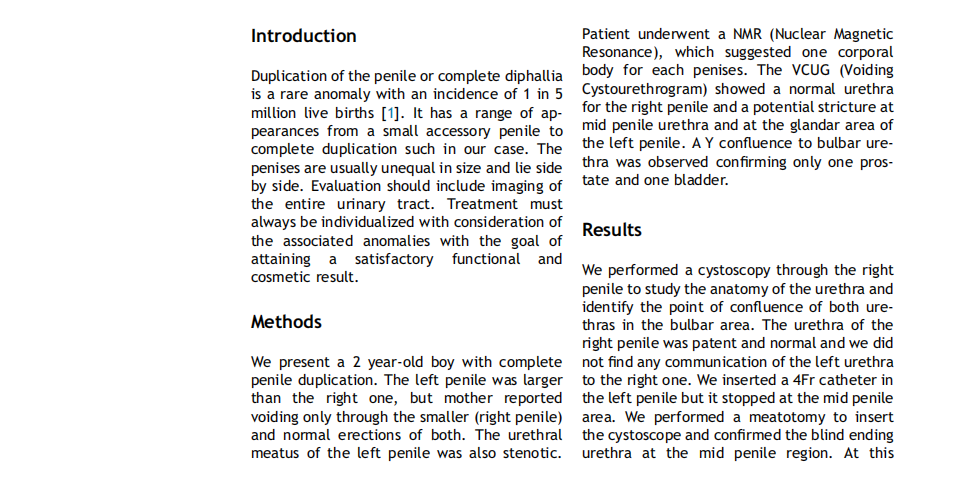
Introduction
Diphallia is a rare anomaly. It has a range of appearances from a small accessory penile to complete duplication.
Methods
We present a 2 year-old boy with complete penile duplication. The left penile was the largest. NMR (Nuclear Magnetic Resonance) suggested one corporal body for each penile and VCUG (Voiding Cystourethrogram) showed a normal urethra in the right penile and stricture at glandular and mid penile urethra of the left penis. A Y confluence to bulbar urethra was observed confirming only one prostate and bladder.
Results
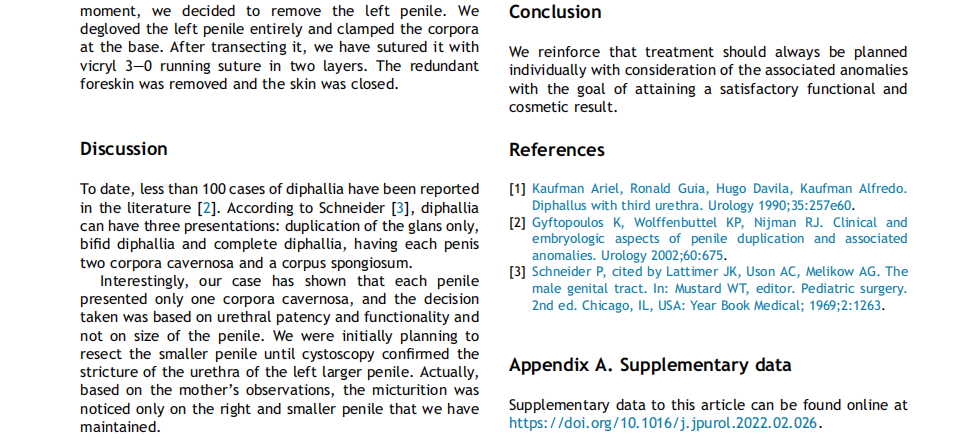
The cystoscopy through the right penile identified the urethral confluence in the bulbar area. We performed a meatotomy in the left penile to insert the cystoscope and confirmed the blind ending urethra. We decided to remove this penile. The penile was degloved entirely and clamped and took out the corpora at the base.
Discussion
Diphallia can have three presentations: only glans duplication, bifid diphallia and complete diphallia (two corpora cavernosa and a corpus spongiosum for each penile). In our case, each penile presented only one corpora cavernosa and the decision taken was based on urethral patency.
Conclusion
The treatment should always be planned individually whereas associated anomalies with the goal of attaining satisfactory functional and cosmetic.
本文转载于Journal of Pediatric Urology (2022) 18, 399_400,不代表本网站赞同其观点和对其真实性负责,我们只作于阅读分享,非商业用途,如若侵权,请告知删除。