本文转载于J.Clin. Med. 2023, 12, 3189.,不代表本网站赞同其观点和对其真实性负责,我们只作于阅读分享,非商业用途,如若侵权,请告知删除。
Rosanna Maniscalco 1 , Giorgina Mangano 2 , Alessandra Capezzone de Joannon 3,*, Matteo Vergassola 3 , Sara Zucchi 3 , Ferdinando Mannello 1 and Lorella Ragni 3
1Unit of Clinical Biochemistry, Section of Biochemistry and Biotechnology, Department of Biomolecular Sciences, University of Urbino Carlo Bo, 61029 Urbino, Italy
2Scientific Consultant, ToxHub S.r.l. Albano Laziale, 00073 Rome, Italy
3Global R&D Angelini Pharma S.p.A, Via Vecchia del Pinocchio, 22, 60131 Ancona, Italy
*Correspondence: 该Email地址已收到反垃圾邮件插件保护。要显示它您需要在浏览器中启用JavaScript。
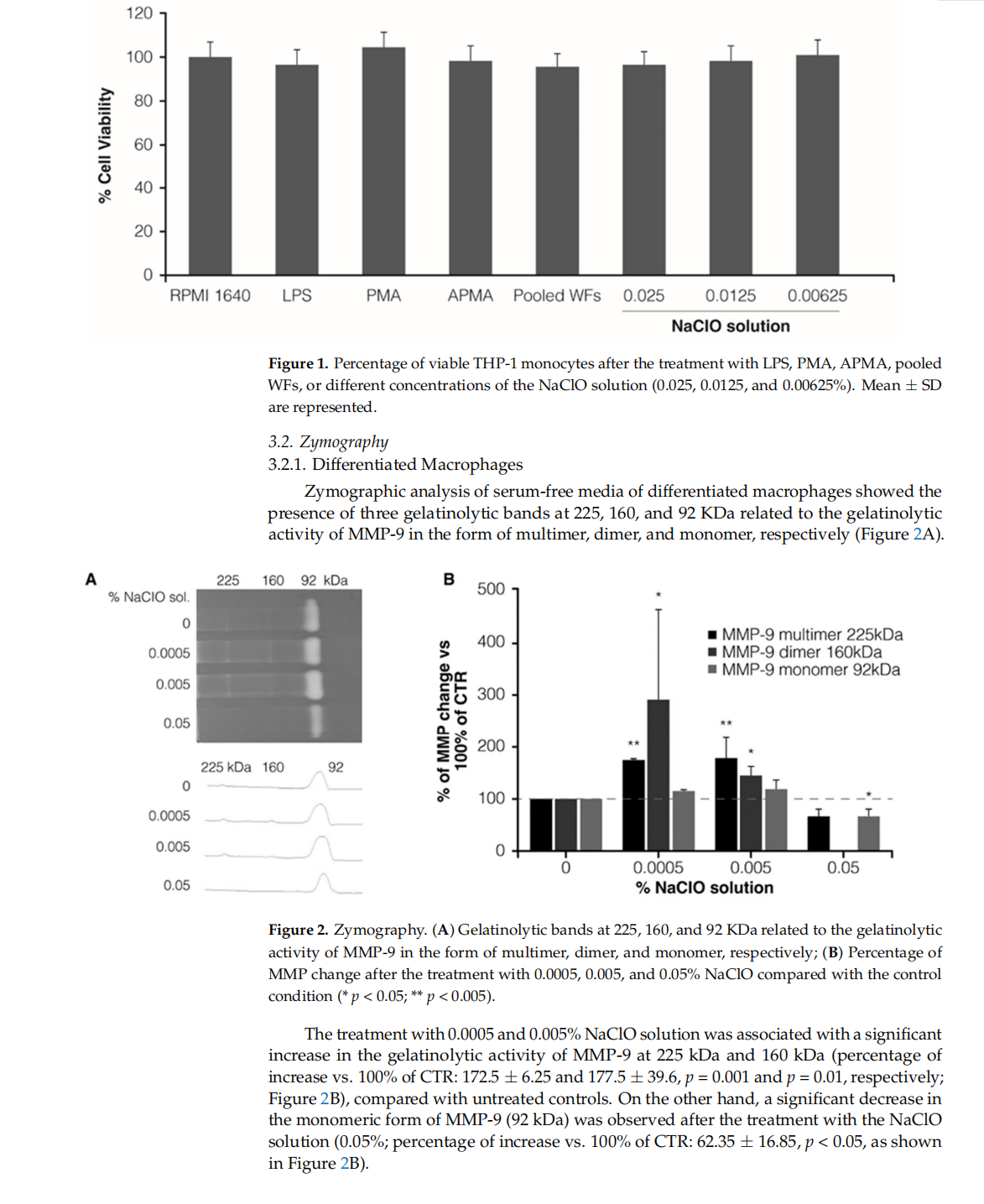
Abstract: Background: In chronic wounds, high concentrations of matrix metalloproteinases (MMPs) can cause excessive proteolysis and slow wound healing. Consequently, restoring a proper MMP balance can help reduce the risk of a chronic wound. An antiseptic solution containing 0.05% sodium hypochlorite (Amukine Med 0.05%, Angelini S.p.A.; hereafter termed NaClO solution) is available on the market. The NaClO solution was proven effective and safe in managing infected skin wounds. To further characterize its activity, this study evaluated the in vitro activity of the NaClO solution on the monocyte release of MMPs. Methods: Human monocytic THP-1 (ATCC® TIB-202™) cell lines were differentiated into macrophages and treated with different concentrations of NaClO (from 0.05% to 5 × 10⁻⁷%). In addition, the THP-1 cell line was stimulated with wound fluid (WF) from patients with active venous leg ulcers in the inflammatory phase. The effect of NaClO (0.025–0.0062%) was also evaluated on healthy human peripheral blood serum samples. The effects of treatments on the gelatinolytic activity of MMP-9 were evaluated by gelatin zymography. The effects on MMPs release were evaluated through the Pro™ Human MMP 9-plex Assay. An exploratory scratch wound healing assay was also performed. Results: The NaClO solution reduced the gelatinolytic activity of MMP-9 and its activated form. The downregulation of MMP-9 gelatinolytic activity was also observed in peripheral blood serum. The MMPs profile showed a reduction in MMP-1 release (p < 0.05) and a slight reduction of the release of MMP-9 and MMP-12 after the treatment with LPS and the NaClO solution. A slight improvement in wound healing was observed after macrophage activation and treatment with the NaClO solution. Conclusions: The results obtained suggest a possible ability of the NaClO solution to modulate the proteolytic pathways in the wound microenvironment, further characterizing its activity and use in clinical practice during wound care.
Keywords: sodium hypochlorite; matrix metalloproteinases inhibition; gelatinolytic activity; chronic wound
本文转载于J.Clin. Med. 2023, 12, 3189.,不代表本网站赞同其观点和对其真实性负责,我们只作于阅读分享,非商业用途,如若侵权,请告知删除。