This article is excerpted from the 《Frontiers in Bioengineering and Biotechnology》 by Wound World.
Wang Shuaishuai 1† , Zhu Tongtong1† , Wang Dapeng2 ,
Zhang Mingran1 , Wang Xukai 1 , Yu Yue1 , Dong Hengliang1 ,
Wu Guangzhi 1 * and Zhang Minglei 1 *
1 Department of Orthopedics, China-Japan Union Hospital of Jilin University, Changchun, China,
2 Department of Orthopedics, Siping Central Hospital, Siping, China
EDITED BY
Xiaoyuan Li,
Northeast Normal University, China
REVIEWED BY
Fuzeng Ren,
Southern University of Science and
Technology, China
Gong Cheng,
Harvard University, United States
Ruogu Qi,
Nanjing University of Chinese Medicine,
China
*CORRESPONDENCE
Wu Guangzhi,
该Email地址已收到反垃圾邮件插件保护。要显示它您需要在浏览器中启用JavaScript。
Zhang Minglei,
该Email地址已收到反垃圾邮件插件保护。要显示它您需要在浏览器中启用JavaScript。
†
These authors have contributed equally to this work
SPECIALTY SECTION
This article was submitted to Biomaterials, a section of the journal
Frontiers in Bioengineering and Biotechnology
RECEIVED 27 October 2022
ACCEPTED 18 January 2023
PUBLISHED 30 January 2023
CITATION
Shuaishuai W, Tongtong Z, Dapeng W, Mingran Z, Xukai W, Yue Y, Hengliang D, Guangzhi W and Minglei Z (2023), Implantable biomedical materials for treatment of bone infection.
Front. Bioeng. Biotechnol. 11:1081446.
doi: 10.3389/fbioe.2023.1081446
COPYRIGHT
© 2023 Shuaishuai, Tongtong, Dapeng, Mingran, Xukai, Yue, Hengliang, Guangzhi and Minglei. This is an open-access article distributed under the terms of the Creative Commons Attribution License (CC BY).
The use, distribution or reproduction in other forums is permitted, provided the original author(s) and the copyright owner(s) are credited and that the original publication in this journal is cited, in accordance with accepted academic practice. No use, distribution or reproduction is permitted which does not comply with these terms.
The treatment of bone infections has always been difficult. The emergence of drugresistant bacteria has led to a steady decline in the effectiveness of antibiotics. It is also especially important to fight bacterial infections while repairing bone deffects and cleaning up dead bacteria to prevent biofilm formation. The development of biomedical materials has provided us with a research direction to address this issue.
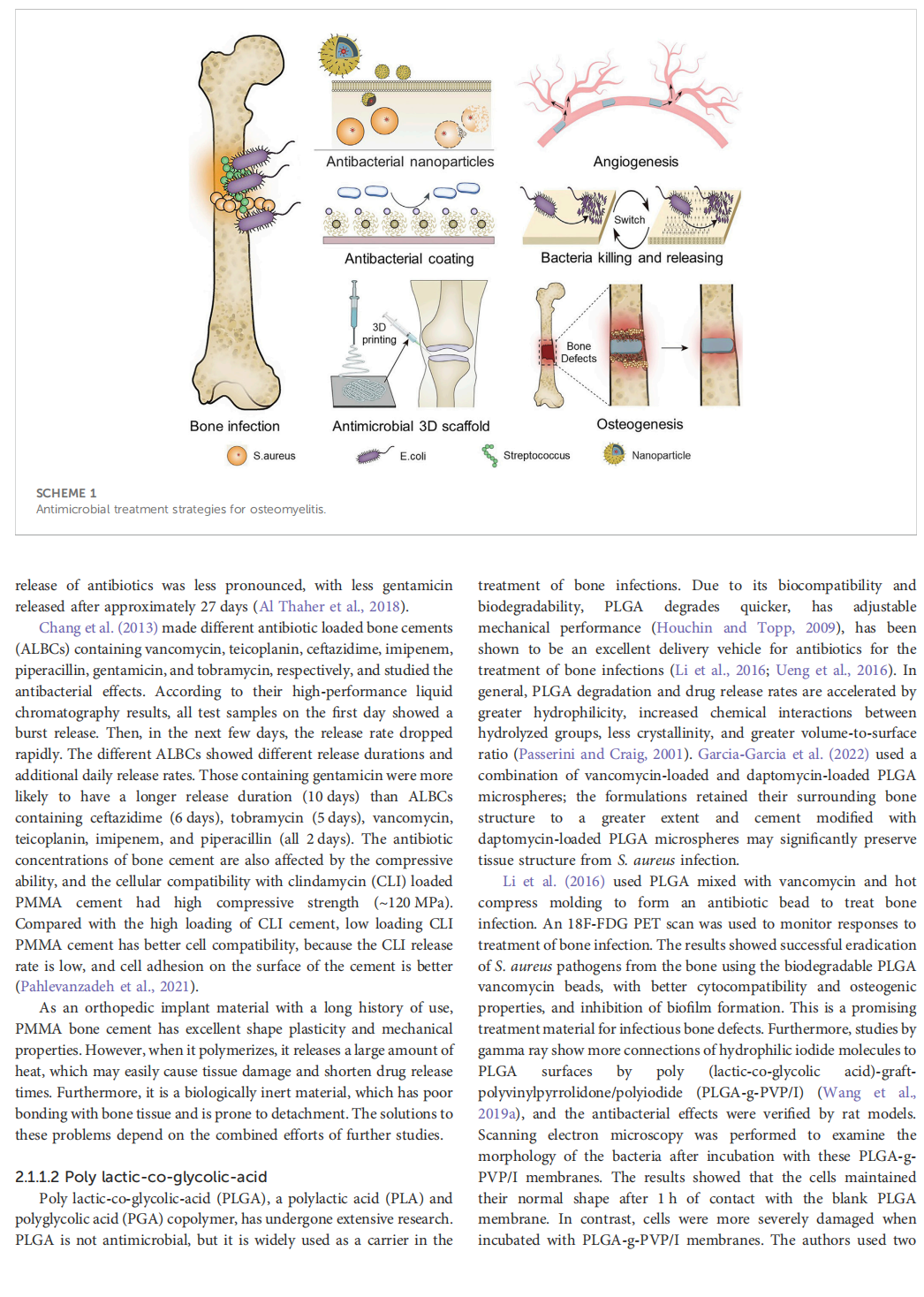
We aimed to review the current literature, and have summarized multifunctional antimicrobial materials that have long-lasting antimicrobial capabilities that promote angiogenesis, bone production, or “killing and releasing.” This review provides a comprehensive summary of the use of biomedical materials in the treatment of bone infections and a reference thereof, as well as encouragement to perform further research in this field.
KEYWORDS
biological materials, bone infection, multifunctional material, implantable material, treatment of bone infection, progress of infection treatment, multifunctionalization of materials
This article is excerpted from the 《Frontiers in Bioengineering and Biotechnology》 by Wound World.