
A.Giaccari1 · G. Gliozzo1 · G. Ciccarelli1 · G. Di Giuseppe1 · C. Castellano2 · S. Cum3 · L. Delle Monache4,13 · M. Gallo5 ·M.Lastretti6 · G. Medea7 · M. Monesi8 · R. Napoli9 · B. Pintaudi10 · E. Succurro11 · G. Turchetti
Received: 9 January 2026 / Accepted: 17 March 2026 © The Author(s) 2026
Abstract
Background and aims Although continuous glucose monitoring (CGM) devices are now standard of care among Type 1 diabetes patients, they are still relatively underutilized in Type 2 diabetes (T2D), particularly in those patients not treated with insulin. Widespread adoption continues to be hindered by a combination of factors. Chief among these is the scarcity of long-term, large-scale clinical trials demonstrating the benefits of the use of CGM in T2D. This meta-analysis aimed to address this gap by comparing CGM with self-blood glucose monitoring (SBMG), with primary outcomes of HbA1c and time in range (TIR) in insulin-treated and non-insulin-treated TD2 patients.
Methods and results Following the stringent rules mandated by our National Health Service (which requires a panel com-posed of all stakeholders involved in diabetes treatment, and includes PICO, GRADE, AGREE, and meta-analyses), we performed a systematic review of RCTs that enrolled two groups of individuals with T2D, those treated with insulin (includ-ing basal and basal-bolus regimens), and those receiving treatments other than insulin. All included trials compared CGM with structured blood glucose monitoring (SBGM) with glycated hemoglobin (HbA1c) as the main endpoint. Based on the strength and consistency of the evidence, the panel issued a strong recommendation in favor of CGM for individuals with T2D treated with insulin (including those on basal insulin alone) and for individuals with T2D not treated with insulin, par-ticularly for those with glycated hemoglobin levels≥7%. From a pharmacoeconomic perspective, outcomes were positive in both patient groups.
Conclusion CGM represents a clinically effective and cost-efficient approach to optimizing glycemic control in T2D, becom-ing mandatory among individuals on insulin therapy. Our findings support a shift in clinical practice toward the more widespread use of CGM in T2D, with regulatory frameworks and reimbursement policies needing to adapt accordingly.
Keywords CGM · Type 2 Diabetes · Metanalysis · PICO · GRADE · Guidelines
Communicated by Massimo Federici, M.D.
A. Giaccari 该Email地址已收到反垃圾邮件插件保护。要显示它您需要在浏览器中启用JavaScript。
1 Center for Endocrine and Metabolic Diseases, Fondazione Policlinico Universitario A. Gemelli IRCCS and Università Cattolica del Sacro Cuore, Rome, Italy
2 Azienda USL of Modena, Sassuolo Hospital, Sassuolo, Italy
3 Diabetes and Diabetic Foot Care Unit, ASUGI, Monfalcone, Italy
4 National Board Member of FAND (Italian Association for the Rights of Diabetic People), Roma, Italy
5 Department of Endocrinology and Metabolic Diseases, AO SS. Antonio e Biagio e Cesare Arrigo, Alessandria, Italy
6 Order of Psychologists of Lazio, Rome, Italy
7 Italian Society of General Medicine (SIMG), Florence, Italy
8 Territorial Diabetology Unit, AUSL Ferrara, Ferrara, Italy
9 Department of Translational Medical Sciences, University of Naples Federico II, Naples, Italy
10 Diabetes Unit, Niguarda Cà Granda Hospital, Milan, Italy
11 Department of Medical and Surgical Sciences, Magna Graecia University, Catanzaro, Italy
12 Institute of Management, Scuola Superiore Sant’Anna, Pisa, Italy
13 Patient Advocacy Lab, ALTEMS – Università Cattolica del Sacro Cuore, Rome, Italy
版权归中华医学会所有。
未经授权,不得转载、摘编本刊文章。
引用本文:简喜超, 简扬, 邓呈亮. 2025版《中国糖尿病足防治实践指南》解读[J]. 中华医学美学美容杂志, 2026, 32(2): 99-103. DOI: 10.3760/cma.j.cn114657-20251215-00266.
通信作者:邓呈亮,Email:该Email地址已收到反垃圾邮件插件保护。要显示它您需要在浏览器中启用JavaScript。
蒋宙男1 戚吉妮!徐伟力’周玥3 张菊芳!浙江中医药大学第四临床医学院,杭州 310053;2杭州市第一人民医院城北院区整形外科,杭州 311203:解放军联保障部队第九〇三医院整形外科,杭州 310013:浙江大学医学院附属杭州市第一人民医院整形外科,杭州 310006通信作者:张菊芳,Email:该Email地址已收到反垃圾邮件插件保护。要显示它您需要在浏览器中启用JavaScript。:10.3760/cma.j.issn.1671-0290.2023.02.021
斑秃是非瘢痕性脱发,现在认为是T淋巴细胞活化介导的自身免疫性疾病!,有自愈倾向。虽然本病不会危及生命,但对患者造成较大的精神痛苦和心理压力。有研究显示,微针有刺激毛发生长的作用[]。本研究对1例斑秃患者采用单纯微针治疗,达到满意效果。
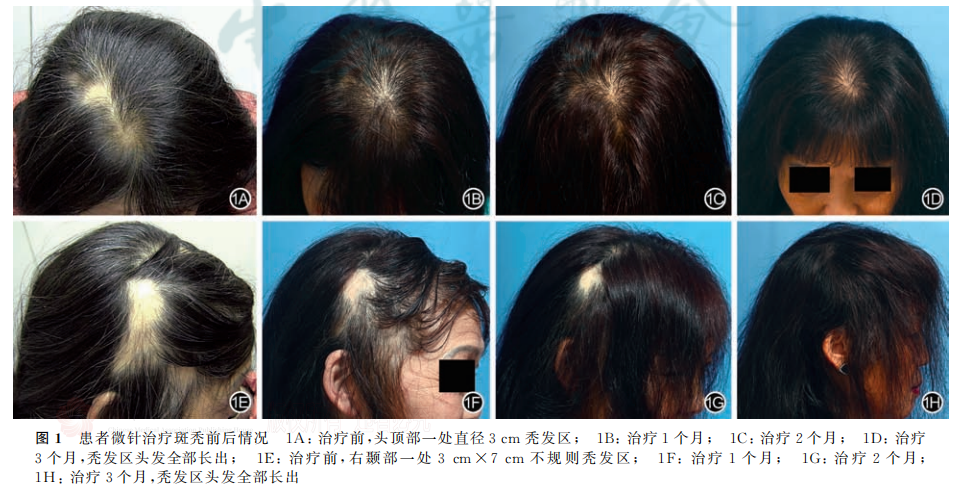
病例 患者,女,58岁。因多发性斑块状脱发12个月余来杭州市第一人民医院整形外科门诊就诊。患者自觉近12个月来头发脱落较严重,以斑状脱发为主。曾接受过曲安奈德皮损内注射、局部糖皮质激素乳音、5%米诺地尔洗剂治疗,均未见明显改善。患者一般情况较好,睡眠质量较差,有高血压病史半年,口服苯磺酸氨氯地平片,一日1片,血压控制可;有焦虑症病史。无家族遗传性脱发史。相关检查:除抗核抗体弱阳性外,甲状腺功能、IgE均正常,真菌镜检阴性、梅毒螺旋体抗体检测阴性。头皮组织病理检查提示毛囊周围轻度炎症细胞浸润,浸润细胞以淋巴细胞为主,有少量嗜酸粒细胞和肥大细胞;可见毛囊微小化及营养不良毛囊。整形外科检查:患者头顶部一处直径3cm秃发区、右题部一处3cmx7cm不规则秃发区;拉发试验阳性。皮肤镜检查可见题部秃发区毛发稀少,毳毛偶见;头顶部秃发区有较多毳毛,可见黄点征、猪尾样毛发和直立性再生发。患者头顶部在治疗过程中再次出现直径约1cm大小的类圆形脱发斑的秃发斑。
治疗经过:我们仅用微针治疗秃发区,每两周1次,共治疗3个月。每次治疗调节微针(一次性使用皮肤点刺针,苏州美沃思医疗科技有限公司),长度1.5mm。治疗前,于患者秃发区外用利多卡因乳音,40min后用生理盐水擦拭和乙醇消毒治疗区3遍:操作者在相同力度下对头皮秃发区反复施针3遍,直至患者头皮出现微红或散在出血点。治疗结束,再用乙醇消毒。嘱患者治疗当天禁止洗头。治疗过程无痛,治疗期间或治疗后均无明显不良反应。每次微针治疗后,患者脱发明显改善。毛发镜下显示,毛发密度、毛囊密度、平均直径、终毛占比和毳毛占比均显著改善。患者定期随访3个月,毛发生长良好,脱发斑块已不可见,且无复发见图 1。
讨论
越来越多的证据显示,微针治疗斑秃有效果。Chandrashekar 等!研究显示,2例斑秃头顶和额头出现秃发区,分别持续6个月和12个月,且曲安奈德皮损内注射、局部糖皮质激素乳膏和5%米诺地尔洗剂治疗无效,用微针联合局部曲安奈德治疗 3次(每隔 3周)后,秃发区毛发再生长,随访3个月斑秃未复发。为排除斑秃自愈的可能,本例患者斑秃处于进展期,病程较长,且各种治疗方法均无效,我们观察到,每次治疗后秃发区及毛发稀疏部位均表现出明显地改善,说明微针可促进斑秃患者毛发再生。
利益冲突 所有作者均声明不存在利益冲突
参 考 文 献
[1]陈军生,何洁冰,魏旷荣,等.斑秃患者血 T 细胞变化及其凋亡信号控制[J].中华医学美学美容杂志,2002,8(1):23-26.DOl:10,3760/cma.j.issn.1671-0290.2002.01.008.
[2]施辛,马维祥.斑秃患者抑郁情绪研究[J].中华医学美学美容杂志,2004,10(4):242-243.DOI:10.3760/cma.j.issn.16710290.2004.04.024.
[3] Kim YS, Jeong KH, Kim JE, et al. Repeated microneedlestimulation induces enhanced hair growth in a murine model[]Ann Dermatol,2016,28(5):586-592. DO1:10.5021/ad.2016.28.5.586. Epub 2016 Sep 30.
[4]Chandrashekar B, YepuriV, Mysore V. Alopecia areata-suc-cessful outcome with microneedling and triamcinolone acetonide[J].JCutan Aesthet Surg, 2014,7(1):63-64. DOI:10.4103/0974-2077.129989.
本文献转载于中华医学美学美容杂志2023年4月第29卷第2期,不代表本网站赞同其观点和对其真实性负责,我们主要用于阅读分享,非商业用途,如若侵权,请告知删除。

伤口世界平台生态圈,以“关爱人间所有伤口患者”为愿景,连接、整合和拓展线上和线下的管理慢性伤口的资源,倡导远程、就近和居家管理慢性伤口,解决伤口专家的碎片化时间的价值创造、诊疗经验的裂变复制、和患者的就近、居家和低成本管理慢性伤口的问题。
2019广东省医疗行业协会伤口管理分会年会
扫一扫了解详情:
任何关于疾病的建议都不能替代执业医师的面对面诊断。所有门诊时间仅供参考,最终以医院当日公布为准。
网友、医生言论仅代表其个人观点,不代表本站同意其说法,请谨慎参阅,本站不承担由此引起的法律责任。